
Tuesday Talks: HT26 Student Takeover
Last week’s Tuesday Talks/Dining with Dinosaurs was a student takeover event, featuring five talks from across three of Reuben’s research themes.
Our five speakers
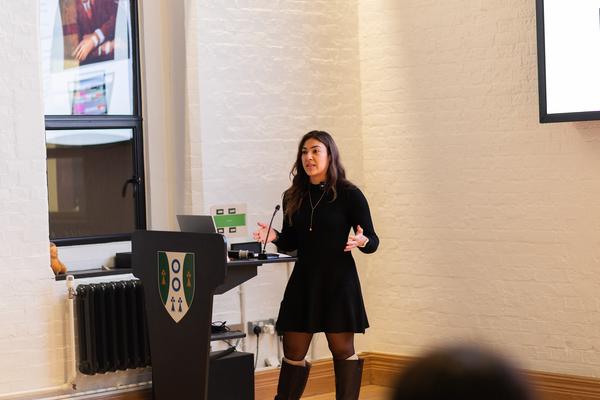
Mikayla Apicella during her presentation (Credit: Simon Devenport)
Mikayla Apicella opened the evening with her talk, Myths, Morals and the Manhattan Project: responsibility, ethical choice and innovation in the atomic age. She took us through her work exploring the morals, awareness and motivations of scientists working in the Manhattan Project. As a scientist myself, I found it very eye-opening. It prompted me to think about the ethics of my own research and its possible future uses.
The next two talks were from the Cellular Life theme. Alexandros Spyrou spoke about how ‘fluid-walled microfluidics’ (a technique using tiny, controlled droplets of liquid to grow and study cells) can help us understand Parkinson’s Disease better. He also showed us some very cool pictures of neurons growing in different formations. Elisa Barrow Molina then discussed new methods for expressing genes in specific cell types. She ended her talk by showing us the translational potential of her work, including testing the technology in a model of cancer drug resistance.
After a delicious main course of fried chicken, we returned to the talks with a presentation from Julia Miklas on quantum sensing. She made a really complicated mathematical topic accessible to a non-specialist audience. Julia showed us how quantum sensors can be far more sensitive than traditional ones, and explained the pros, cons and challenges of quantum technology in computing.
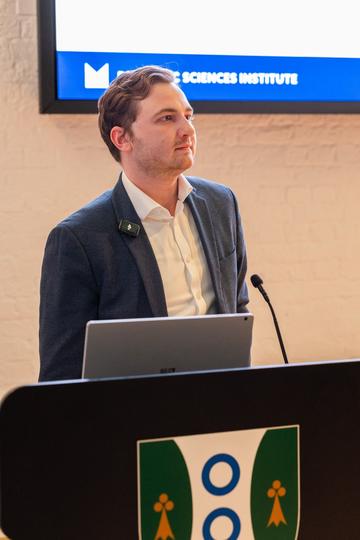
Jakub Hantabul hearing from the audience (Credit: Simon Devenport)
The final speaker was Jakub Hantabal, whose research focuses on viruses and pandemic response. His topic was relatable to the audience and sparked lots of questions. He focuses on Nipah virus, a zoonotic virus (one which can naturally transmit from animals to people) which has had recent outbreaks in Bangladesh and India. He uses related viruses and organoids in the lab, which are lab-grown clusters of cells that mimic real organs. This method helps him study Nipah safely and cost-effectively. Jakub ended by stressing the need for international and interdisciplinary collaboration to combat future pandemics effectively.
Questions and ethics
Each speaker provided questions on their topics, which the audience spoke about over a very popular dessert course of doughnuts. We then followed on with a very interesting discussion with the speakers; each one was encouraged to talk about the biggest ethical question in their field.
All in all, the evening was another hugely successful student takeover event. I hope these continue to feature in future terms’ Tuesday Talks!

