
Tuesday Talks: TT26 Student Takeover
Tuesday evening saw the return of the Tuesday Talks: Student Takeover, which gave us the chance to hear about what various Reubenites have been working on across a range of topics. These evenings have always been a highlight of the term and this one did not disappoint.
Our student speakers
Fatima Warraich
The evening’s talks began with Fatima Warraich, who spoke on The role of social protection in mitigating the impact of climate shocks on education and child labour. She showed us how difficult it is to measure how much major climate events affect the lives of children. Fatima also highlighted the challenge of balancing direct, short-term support for families with longer-term investment in education. How should governments balance urgent survival needs with long-term support to help people flourish? This led to interesting discussions about what leaders should prioritise as these climate events become more common in many parts of the world.
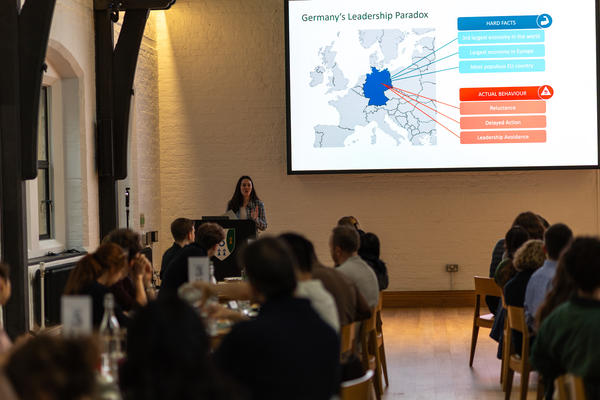
Theresa Scheule
We also considered the role of government in Theresa Scheule's Why do countries act the way they do? Theresa explored what motivates the major decisions that governments make. Many of them are not always driven by security, resources, or voter popularity. Instead, they are based on how a country sees its own history and international role. We questioned whether any new problem can (or should) be considered separately from a country’s past. Some ideas arose about how we can include history and identity in a framework for understanding the reasons for certain decisions and how to justify them.
Christina Arguello
Christina Arguello explored decision-making again, but in the context of medical care, in Seeing risk, assigning responsibility: spatialising visibility and accountability in healthcare.
By looking at physical spaces and objects, Christina showed us how things that are easy to miss can still affect important choices. This can make it hard to decide who, or what, is responsible when something goes wrong. We got some insight into how to explore this through policy documents and investigations into adverse events. In many cases, understanding responsibility means considering the systemic issues and the complex healthcare system around them.
Emery Hoos
Emery Hoos' talk, Turning your own cells into cancer therapy, gave us a crash course on immuno-oncology (how we can use the immune system to fight cancer). As part of this, Emery explained the cutting-edge work on personalised treatments. These are important for people with cancers that have spread across the body and not responded to other treatments. The talk showed how new advances in biotechnology together with understanding immuno-oncology could help move cancer treatment beyond the traditional approach of ‘cut, poison or burn’. It offers hope to patients with advanced disease and no options left.
Lilli Freischem
We finished the evening with Lilli Freischem’s How the OUBC women's squad turned the tide. With a casual air, Lilli talked us through a remarkable journey of grit, determination, and culture change. Her talk showed how dedication to a long-term goal helped Oxford Women’s Boat Club achieve world-leading performance, making Oxford a force to be reckoned with in rowing once more.
Lilli challenged us to be honest about our greatest goals and to face them without fear of failure. She has admirably already moved on to discussing future Boat Races and international trials. We wish her the best of luck!

