

Conference report: Diagnostics for Low- and Middle-Income Countries 2026
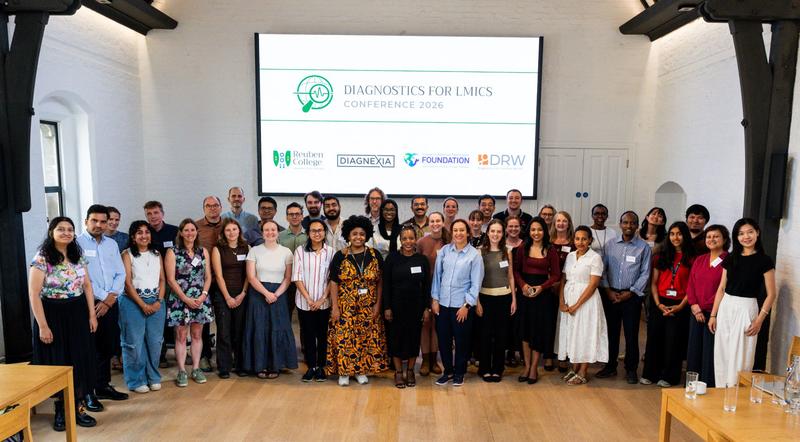
Attendees of the 2026 Dx4LMICs
This year marked the fourth Diagnostics for Low and Middle-Income Countries (Dx4LMICs) conference to be held by Reuben College, Oxford. As in previous years the conference was held over two days and the president of our college Professor Lord (Lionel) Tarassenko welcomed over 120 attendees to Oxford’s newest college. The conference attracts researchers from a wide range of disciplines; these range from the social sciences through to clinical researchers and machine learning specialists.
One of the strongest messages from last year’s delegates was that they wanted more opportunities to interact with one another. We wanted to encourage more collaboration between our attendees and so introduced several interactive elements borrowed from ‘unconferences’. These ranged from structured networking sessions through to lightning talks and breakout sessions. We hope that these programmed sessions, as well as the ability to talk to people during coffee breaks, lunch or dinner, meant that everyone who attended went away having made at least one new connection.
Day One, Wednesday 30 June
Professor Mike English and Dr Anne Ferrey started the conference with an excellent keynote about the importance of considering the human aspects of how a new technology or test might be used and incorporated into existing workflows. It is all too easy for us as researchers in a university to think that all we have to do is build a better test and people will start using it, but as they eloquently pointed out that almost never happens! Then we heard from Dr Cathal Mills about his work modelling the impact of climate change on the spread of different mosquito borne diseases stop.
After coffee, we asked that all the attendees sat at a table where they did not know anyone else, so we could run a structured networking session. Each pair had only four minutes to introduce themselves, describe what their interests were and then see if/or what common ground they had. This was a resounding success in getting everyone to talk to someone new. Bringing the session to a close we held the lightning talks. In keeping with the spirit of the conference, all attendees could vote on which lightning talk and poster were their favourites.
After lunch, during which the posters were viewed, we heard from Dr Tapabrata Chakraborty about a pragmatic approach in dealing with the paucity of patient data in LMICs, by retraining machine learning models rather than starting from scratch. Then, Professor Catrin Moore gave a thought-provoking talk about the trial she is running in Uganda, looking at how women access care for urinary tract infections. Finally, Dr Trhas Tadesse (AfOx Fellow) described the difficulty of diagnosing screening for preeclampsia in Ethiopia. We reconvened for pre-dinner drinks at 7pm before enjoying an excellent conference dinner thanks to one of our sponsors, Diagnexia, with an after-dinner speech by Dr Bernie Croal (President of the Royal College of Pathologists).
Day Two, Thursday 1 July
Three talks before coffee – Dr Gisela Robles Aguilar kicked us off by showing some of the results of the GRAM project, before Dr Joe Knapper from Glasgow showed us his OpenFlexure microscope with 3D printed stage; this is one of those projects which keeps finding new uses. It is thanks to the support of the College of American Pathologists that he was able to travel down to Oxford and give his talk. Then, Dr Adamu Addissie (Addis Ababa University) talked about the ground-breaking work his team is doing on self-sampling for HPV screening to reduce the incidence of cervical cancer in Ethiopia. After coffee, Professor Manisha Nair talked about Smart FoCUS; her project to help non-specialists use ultrasound devices to diagnose cardiac conditions for mothers in India.
The next part was our most ambitious interactive element; we had distilled down all the suggestions into eight distinct topics. We asked everyone to self-organise into groups that would discuss each topic, before, most importantly, suggesting two questions to ask the panel. During lunch, these questions were distilled yet further and used by Professor Gari Clifford to chair an interesting panel discussion. Professor Guy Thwaites, who led for many years the Oxford University Clinical Research Unit in Vietnam, closed the conference with a talk examining the opportunities and challenges of innovating in diagnostics in South East Asia. We finished with a group photo and the prizes to the poster and lightning talk winners.
We look forward to welcoming everyone back for the fifth Dx4LMICs conference in 2027. Keep an eye on the Reuben College website for details of next year’s event.

