


National news coverage on ‘superfood’ that could help save bee populations features Reuben student
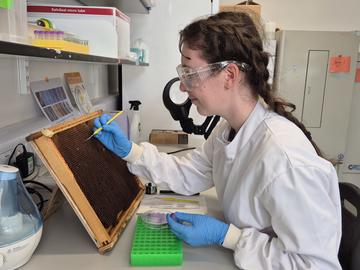
Jennifer Chennells sampling larvae from a comb, Oxford Bee Lab. (Credit: Caroline Wood)
Jennifer Chennells, a Reuben student working in the DTP in Environmental Research, has been featured in BBC News coverage of a groundbreaking Oxford study that could help save struggling honeybee populations worldwide. The research, led by Dr Elynor Moore (part of Professor Geraldine Wright's Oxford Bee Lab at the time of the study, now at Delft University of Technology), developed an engineered 'superfood' supplement with all of the nutrients that bees need to survive.
Currently, honeybee populations are dwindling due to factors such as nutrient deficiency, habitat loss, and ongoing environmental change. While beekeepers provide colonies with artificial pollen substitutes to fight regular flower shortages, these feeds lack essential nutrients called sterols that bees need to thrive. Jennifer, who works on bee nutrition research in the lab, was featured in the BBC coverage to discuss the importance of this type of work for bee health and survival.
Through CRISPR-Cas9 gene editing, Dr Moore and her colleagues have been able to engineer a yeast that can provide the six sterols that bees require to sustain themselves. When monitored in a three-month trial, bee colonies that ate these supplements had up to 15 times more baby bees that grew to adulthood.
This technological breakthrough offers hope for bee survival and, following further trials, could be accessible to farmers within two years. As honeybees are responsible for pollinating one in three crops, this also provides a large step forward for global food security.
You can learn more about Dr Moore's sterol research in Dr Moore's article recently published in Nature.

