For Women’s History Month, we’re sharing the stories of just a handful of women in our community whose work is shaping the future.
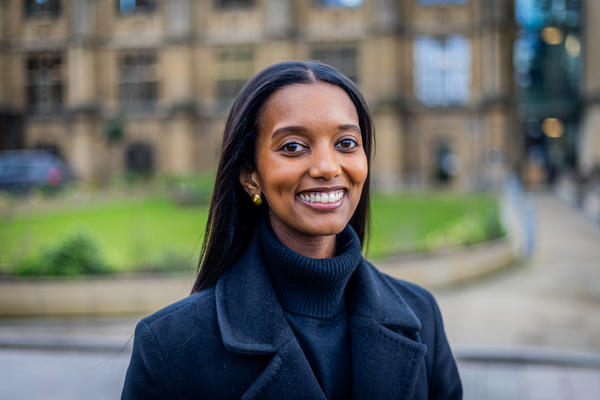
Tsion Syoum (DPhil in Geography and Environment, 2024) has already worked with governmental ministries, NGOs, schools, and communities to improve access to clean water, but isn’t stopping there. Through her research, she’s looking to better understand how water, sanitation, and hygiene (WASH) systems are governed and measured in schools, with the aim of improving how essential services reach communities that need them most.
Q&A with Tsion Syoum
What first inspired your work on water access?
"I’m a first-generation American, who is also proudly of Eritrean origin. Growing up, I spent a lot of my childhood summers in Eritrea since my grandparents and extended family lived there.
Coming from an American background with strong ties and roots in Eritrea, it gave me a dual perspective on the global water crisis. My positionality has informed my understanding of how countries in the Global South, including my own, disproportionately bear the burden of challenges related to water management and I wanted to find a way to contribute my share to making impactful change."
What action did you take?
"My first mode of action was writing an email to the Ministry of Land, Water and Environment in Eritrea, because I didn’t know who else to talk to. At first, they thought I was part of a large organisation or backed by investors.
When they learned that I was a 15-year-old girl they were understandably surprised, but ultimately very supportive of my initiative.
Once I received the green light for the project, I began mobilising resources through grassroots fundraising campaigns. Over the course of seven years, the project expanded, and I raised $45,000 to support sustainable water infrastructure. This included a hand pump well, an extended pipeline system, and the rehabilitation of another hand pump for a rural school in Sheki Wedi Bisrat.
Later, I discovered that this was the same elementary school my grandmother had attended, she was the first girl to graduate from that school. Being able to return and support the community by providing a sustainable water source felt like a true full-circle moment."
How has that experience shaped the research you’re doing today?
"A lot of what I’m doing now on water, sanitation, and hygiene (WASH) in schools is heavily influenced by my background in working closely and directly with those communities at the outset of my journey.
My focus at the moment is on institutional barriers to sustainable WASH services in schools in Zambia, exploring how governance, measurement, and monitoring systems shape decision-making and long-term service delivery outcomes."
How are you making history?
"I hope my contribution, either through research work or NGO work in water service delivery, will bring lasting solutions to combat the global water crisis and bring important initiatives and dialogues on the topic of WASH at a global level.
I want to continue supporting and advocating for communities whose voices are often underrepresented in decision-making. Wherever my career takes me, I want to remain grounded in working directly with communities."